
TL;DR
Stablecoin volumes have surpassed major card networks, but the trust infrastructure needed to operate at institutional standards has not kept pace. The risk decision in stablecoin transactions has to happen before funds move, not after, and it has to work across fiat and digital rails together. Range is building that unified control layer. We invested because institutions shouldn’t have to choose between speed and certainty.
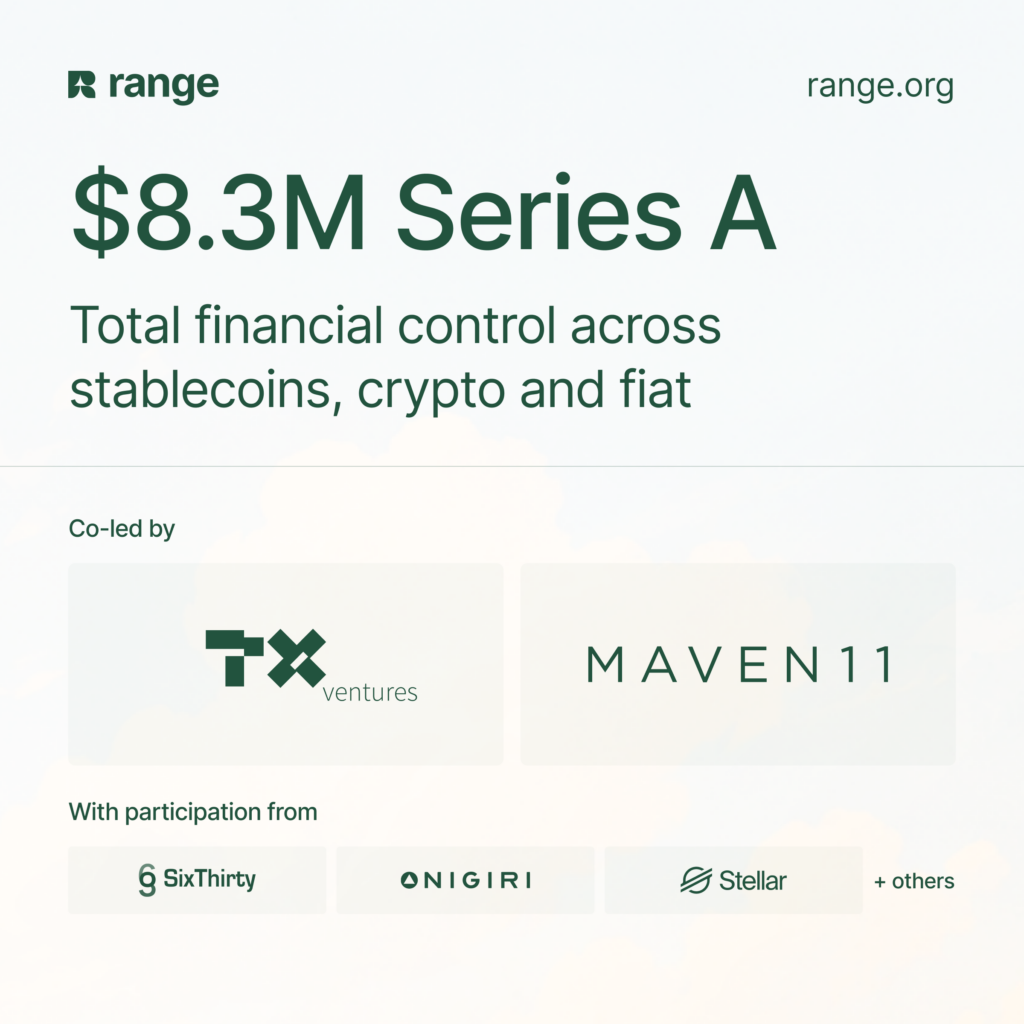
At SixThirty, we invest at the intersection of health, wealth, and privacy, focusing on the platforms and infrastructure reshaping banking, insurance, and asset management. Today, we are excited to announce our investment in Range – a unified platform for control over real-time security, risk, and compliance across fiat and stablecoins. If stablecoins become programmable money, Range is building the transaction infrastructure that makes that money usable without compromising institutional standards; raising the bar for present day speed-to-trust.

The thesis: tokenization is real, but it needs a robust Trust infrastructure
We have previously highlighted the shift in financial services –the steady work of reformatting traditional assets onto programmable rails. Tokenized assets under management are projected to reach nearly $19 trillion by 2033, while stablecoin volumes have quietly surpassed those of major card networks. As this shift accelerates, asset managers and wealth platforms are asking a critical question: how do we participate while meeting institutional standards for risk, audit, and oversight?
That question doesn’t get answered without a holistic trust layer across fiat and stablecoins. In traditional finance, trust is embedded in the network: known counterparties, compliance gates, settlement windows, chargebacks, audits, and recourse. Stablecoins unbundle that trust. They make value move faster, across more endpoints, with fewer built-in safeguards and outside of walled gardens. For institutions, the question is not whether stablecoins can move money. It is whether they can move money safely, compliantly, and with enough assurance to support enterprise-scale adoption with trust still intact.
Any network platform bold enough to embrace more endpoints, faster, and with greater confidence would have to secure the following core strengths:
1) early: situated at the source of initiation
2) instant: executable at near-real-time
3) direct: integrated seamlessly into treasury endpoint flows
4) holistic: enabling a total approach across fiat and stablecoins.
Yes, stablecoins compress settlement time from days to seconds. Definitively, this changes the nature of risks to manage. And, indeed, in traditional payments, trust is built through closed networks, known counterparties, reversibility, and after-the-fact dispute processes. However, in emergent stablecoin payment flows, the transaction is often instant, cross-chain, and irreversible. The trust decision –in order to stay intact- therefore has to move upstream: before funds move.
While the crypto industry has sprinted toward scalability and sovereignty, the pace of securing that innovation has lagged. Several high-profile exploits have drained billions of dollars, with losses often going undetected for days. These incidents serve as stark reminders that the future of finance cannot rest on infrastructure that lacks the digital equivalent of a vault or a lock. For institutional capital to flow into tokenized assets at scale, this security gap must be closed.
We do not believe the future of stablecoins will be purely closed or purely open. Large financial institutions will build private and bilateral networks where appropriate. But the broader direction of travel is toward a more fragmented, multi-chain, multi-custodian market: issuers, PSPs, wallets, fintechs, banks, treasury platforms, and protocols all interacting across different rails. In that world, no single institution can rely only on static counterparty lists or post-transaction forensics. The market needs a shared intelligence layer that can establish trust at the moment a transaction is initiated. And, for this to happen at scale, institutions need to incorporate a unified approach across fiat and stablecoin rails.
This is where Range comes in.
What Range is building
Range is a real-time risk, compliance, and execution platform for the multi-chain, stablecoin-enabled financial system that unifies all wallets, custodians and bank accounts across fiat and stablecoins.
With its upstream positioning, Range answers three institutional questions in real time: who am I sending to; will the transaction settle as intended; and what recourse exists if something goes wrong?
Their tools span:
- Real-time risk intelligence –sanctions screening, behavioral analytics, and AI-driven scoring across wallets, transactions, tokens, and smart contracts
- Cross-chain stablecoin execution –best-price routing, integrated compliance, and Travel Rule documentation built into the transfer itself
- Monitoring and detection –live visibility into treasury movements, liquidity, mints and burns, and anomalous flows before they become losses
- Developer infrastructure –APIs and a normalized data layer that lets institutional builders embed compliance and risk directly into their own products
Critically, Range delivers all of this as an integrated platform rather than a stitched-together patchwork of point solutions. For institutions accustomed to enterprise-grade infrastructure, that consolidation matters: it eliminates vendor sprawl, simplifies audits, and reduces the surface area where things can go wrong. The Range platform is already trusted by ecosystems including Stellar and Solana, and it sits squarely on the rails that asset managers, wealth platforms, and stablecoin issuers will increasingly depend on.
Performant treasury doesn’t need another dashboard, it needs better execution
What makes Range especially compelling is how it sits in the flow, rather than around the flow. The company is not building another dashboard for after-the-fact investigation. Range is moving risk intelligence into the flow of funds itself. Its pre-transaction risk engine can deliver a go / no-go / withhold decision before settlement, while Faraday extends that position into routing and transaction execution. That matters because the highest-value infrastructure companies are not merely systems of record; they become systems of action.
Why this round? Why now?
The timing matters. Stablecoin supply has grown from a crypto-native settlement tool into a serious candidate for global payment, treasury, and tokenized-asset infrastructure. As volumes move from pilots to production, the bottleneck shifts. The question is no longer whether blockchains can settle value. The question is whether institutions can understand, approve, monitor, and insure that movement of value with the same confidence they expect from existing financial rails at the speed requisite for the systematic overhaul of payments and treasury to work. Institutions should not have to abandon those high standards or make compromises around performance expectations. They should transact with greater speed and greater certainty and it is time for a player to architect the delivery of both.
Why this fits our portfolio
SixThirty has been deliberate about building a portfolio underpinning the tokenization stack and the financial networks they establish. Particula brought us risk ratings and analytics for tokenized financial assets. Osyte brought us multi-asset portfolio management and execution at scale. AiPrise orchestrates the entree of trusted transactors into secure networks, compliantly. Range spans the real-time intelligence layer beneath them – the operational backbone that makes the stack institutionally proofed when transactions span on-chain endpoints.
Put differently: as wealth and asset management migrate to tokenized rails, the institutions doing the migrating will need infrastructure that looks and behaves like the operational backbone they already rely on – auditable, real-time, AI-native, and built for regulated environments. Custody, clearing, settlement, and surveillance functions don’t disappear in a tokenized world; they get rebuilt for it. Range is doing exactly that for the security and compliance layer.
We also see a deeper alignment with how AI and tokenization are converging. Range’s data advantage, applied to a domain –on-chain financial activity- lands in a domain where the threats are adversarial, and the cost of getting it wrong is measured in headlines and recovered funds. AI matters here because the data foundation is particularly abundant and Range’s capabilities are expressed in a manner that is particularly strong. On-chain activity is structured, timestamped, and behaviorally rich but the challenge is interpreting it quickly enough to support real-time decisions. Range’s proprietary indexers, entity intelligence, and transaction history give its models the kind of signal that generic tools struggle to reproduce. AI is not the thesis by itself –it is an accelerant on top of Range’s data advantage.
On-chain data is uniquely well-suited to machine learning: it’s structured, complete, timestamped, and globally accessible. Range is one of the rare companies positioned to take full advantage of that, training models on the kind of behavioral signal traditional fraud and AML systems can only approximate. That’s the kind of problem where AI earns its keep, and where the combination of AI plus tokenization produces something neither could deliver alone.
Why this team
The Range team, led by Andres Monteoliva, has lived the security problem from the inside. They have built DeFi protocols, audited systems holding tens of billions in TVL, and disclosed critical vulnerabilities in major networks. They didn’t arrive at this problem from the outside looking in –they’re the people the rest of the industry has called when something has gone wrong. That credibility is why Range has earned the trust of serious ecosystems through technical merit rather than marketing, and it’s why we believe they can earn the trust of regulated financial institutions next.
What’s also evident from working with the team is a clarity of conviction. They believe security is the constraint that has to be solved before mainstream adoption is possible, and they’re building like it. In our experience, founders who frame their mission that sharply –and who back it up with the technical chops to deliver –are the ones who go on to build category-defining companies.
“Tokenization without a unified trust infrastructure across fiat and stablecoins is a non-starter for institutional capital. Range is building that trust layer for the multi-chain, stablecoin-enabled financial system –and they’re doing it with the technical depth and credibility regulated institutions will require. We’re proud to back them.”
— Chandresh Iyer, General Partner, SixThirty Ventures
What’s next
We’re proud to back the Range team as they build a category-defining platform for the future of on-chain finance. As tokenization moves from pilot to production inside asset and wealth management, the firms that win will be the ones whose infrastructure is trustworthy by default. Range is making that possible.
Welcome to the SixThirty family.
